
What is Bubble?
Bubble is a comprehensive visual programming platform that allows you to construct, design, secure, and host massive web applications in a single unified dashboard. Its layout system leverages a pixel-level drag-and-drop editor paired with a fully responsive custom layout engine, letting you style widgets and pages with absolute precision. Underneath, Bubble provides a managed relational database and a logic designer that mimics real visual code compilation, enabling multi-step client workflows, backend scheduler events, and server-side operations without writing code.
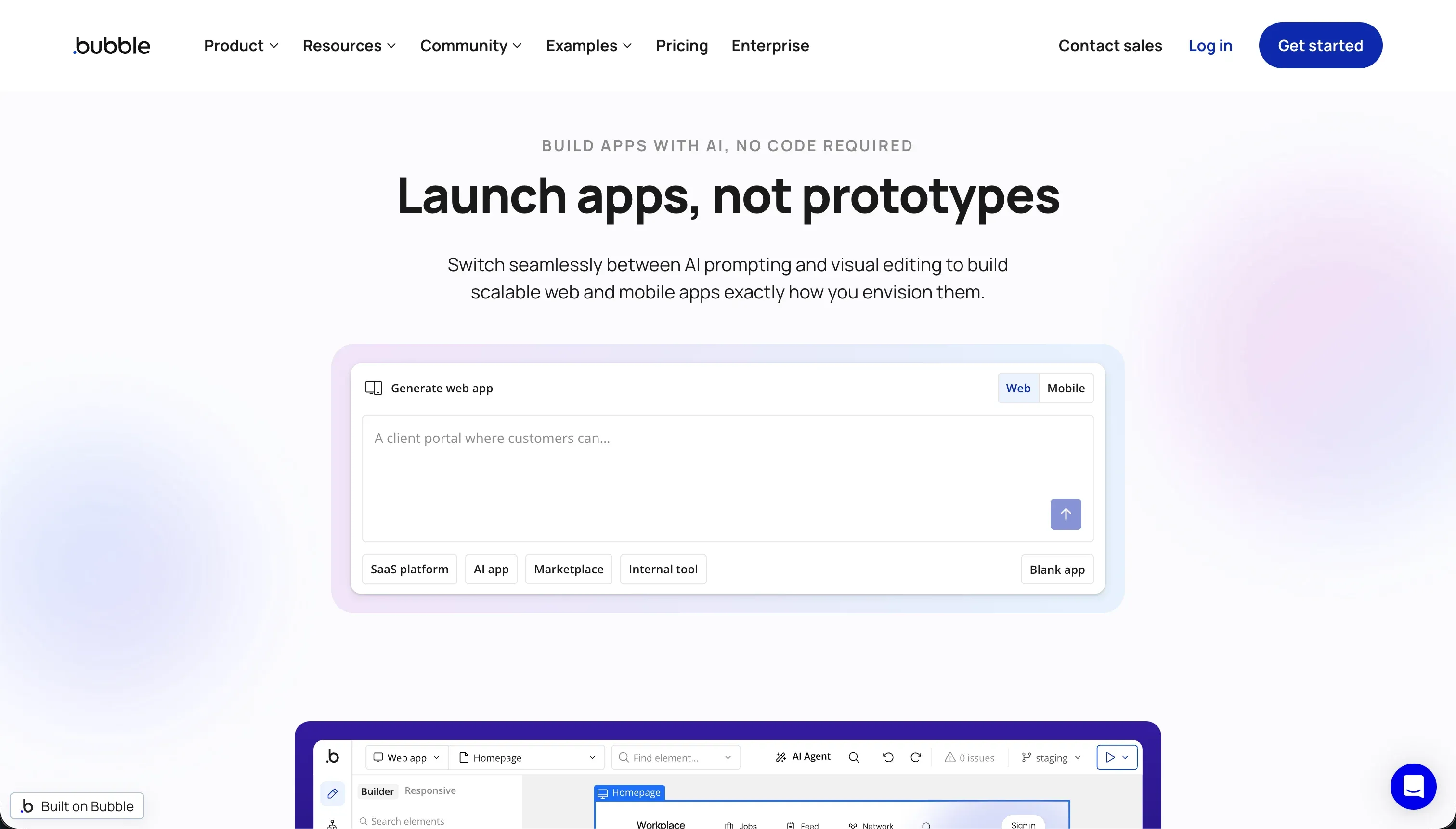 Bubble homepage snapshot
The core bet of the platform is that visual programming should not mean sacrificing functional power. Unlike lightweight builders that only assemble aesthetic interfaces, Bubble structures user actions with real database queries, structured variables, and granular privacy configurations. The result is a highly capable product that forces you to think like a classic software developer, trading off a fast initial setup for the ability to build almost anything you can invent.
What can you build with Bubble?
The honest sweet spot of Bubble is complex, database-heavy web applications that require multi-user dashboards, unique user roles, and advanced relational logic.
- SaaS MVPs with custom subscription billing, distinct dashboard layouts, and complex logic routes
- Client portals with precise access layers, document tracking, and custom communication streams
- Directory and booking apps managing real-time schedules, reviews, and search indexing
- Internal operational platforms that unify disconnected databases, forms, and custom employee workflows
What makes these apps work is the granular server-side architecture. You define exact data fields, map complex object-to-object relationships, and create visual triggers that handle payments, alerts, or data processing instantly. However, where it stops is high-performance real-time search queries and heavy read/write operations. When your database grows into millions of daily relational records, Bubble begins to feel the limits of its shared relational structure, lagging heavily unless your workflows are optimized with veteran developer precision.
What users are saying
The community feedback on Bubble is starkly polarized, reflecting both its peerless design freedom and its unforgiving infrastructure system.
- Best-in-class custom application and workflow logic controls
- Unmatched programmatic API connector for external LLM integrations
- Massive ecosystem of over 8,000 plugins and visual templates
- Fully secure, granular server-side database privacy rules
However, user complaints cluster heavily on the brutal opacity of the billing system and severe vendor lock-in. Reddit and community forums are filled with warnings of abrupt account shutdowns when credit caps are breached, along with lagging screens on the visual editor when projects grow complex. Many expert reports highlight structural performance issues once multiple users start hitting unoptimized workflows, dragging RAM consumption on editors into multi-gigabyte leaks.
Performance is weak especially if you start having a lot of users. You will at some point realize you can’t achieve something specific. It’s expensive. You’ll be locked in, you won’t be able to move out easily once you choose Bubble.
Our read: Bubble is a visual titan that empowers builders, but its walled garden has steep edges. If you build efficiently, you get a scalable software system; if your workflow configurations are sloppy, the platform can quickly become expensive to sustain on its shared database infrastructure.
What it costs in practice
Bubble’s pricing model is split across visual plans that dictate your core design features and Workload Units (WUs) that calculate server resource consumption.
| Plan | Price | Included Workload Units (WU) | Best For |
|---|---|---|---|
| Free | $0 | 50k WU/month, 200 records | Learning and testing visual ideas |
| Starter | $69/mo | 175k WU/month | Live solo apps and small MVPs |
| Growth | $249/mo | 250k WU/month | Collaborative production systems |
| Team | $649/mo | 500k WU/month | Agencies and high-traffic software |
The behavior of Workload Unit billing is famously volatile. Because every action (like a search query, API ping, or visual database update) consumes a fraction of a Workload Unit, poorly designed page filters or database loops can run up massive overage charges without any warning. And the failure mode is harsh: community reports document apps on expired paid plans dropping to free-tier limits and getting shut down outright, with a Bubble error screen where the home page used to be.
We recommend three distinct pricing practices:
- Audit active data searches to limit real-time repeating groups from firing endlessly.
- Use database privacy rules to stop pages from fetching data objects they don’t need.
- Execute bulk data processing inside background workflows scheduled during off-peak windows.
What are Bubble’s common alternatives?
Choosing the right alternative depends on how much visual freedom and database structure your application requires.
| If you want… | Look at | Why |
|---|---|---|
| Structured business apps with fast setup | Softr | Visual assembly with pre-built blocks and flat application-user pricing without visual complexity |
| Real code you own, with hosting built in | Replit | The agent builds a real codebase on real infrastructure, though maintaining both becomes your job |
| Complex mobile apps for app stores | FlutterFlow | Native mobile performance and visual components with easy code export and less vendor lock-in |
| Slick visual prototypes with AI generation | Lovable | Generates complete web layers rapidly with AI prompts, but requires developer skills to maintain |
| A visual frontend on a backend you control | WeWeb | Strong visual builder that connects to your own database instead of locking data inside the platform |
While Bubble remains a powerful force in the no-code ecosystem, several alternative platforms address its common limitations in data ownership, mobile deployment, and learning curve. For teams that want to build structured business applications without getting bogged down in spatial layout or complex logic systems, Softr offers a much faster path to deployment. It uses pre-built blocks to assemble websites and portals while offering predictable flat pricing, making it far simpler to manage than Bubble. If your priority is native mobile performance and app store deployment, FlutterFlow provides a superior option with its visual component builder and clean code export, allowing you to bypass vendor lock-in entirely.
On the other hand, developers who want complete control over their application architecture are looking toward decoupled setups or AI-driven generation. WeWeb excels at creating highly polished visual frontends that connect directly to external databases, ensuring you retain full control over your backend rather than trapping data inside a proprietary system. For those who want to leverage artificial intelligence, Lovable rapidly generates complete web layers through simple text prompts, though it requires some traditional developer skills to maintain over time. Finally, Replit offers the middle ground of automated code generation on real, hosted infrastructure, which gives you absolute ownership of the source code while tasking you with its long-term maintenance.
Choosing the right alternative ultimately depends on whether you value ease of deployment, mobile optimization, or total control over your underlying codebase.
Who Bubble is for (and who it isn’t)
Bubble is our recommendation for serious builders and agencies who need to build fully customized full-stack web applications and are looking for a complete development system. It remains a standard in our best no-code platforms for vibe-coding and best vibe-coding tools for agencies because no other visual editor matches its depth for constructing databases and mapping multi-step visual workflows from scratch.
However, you should skip it if you are a non-technical builder seeking to quickly spin up internal tools or client portals without tackling database schemas. In that operational lane, a platform like Softr is far better, providing secure out-of-the-box templates and clean layouts without the risk of expensive pricing spikes. If you are prepared to invest months of learning to master visual logic and database configurations on a hosting engine you never truly own, Bubble is the most capable sandbox on the web.