


Every team eventually wants a CRM shaped like their own pipeline, not the one a SaaS vendor decided on. Vibe coding makes a custom CRM realistic for the first time, but a CRM is a real database of real customer data with multiple people writing to it, so the boring parts (permissions, relationships, not losing records) matter more than the demo.
This ranking is part of the internal tools family. To find the right engine, we ranked these platforms strictly on execution resilience under multi-user CRUD operations, rather than rapid visual prototyping. A real CRM is the absolute heart of your sales team’s daily workflow, demanding deep data security and reliable relational linkages that don’t crumble under daily updates.
1. Softr - the database-first system that handles CRM security visually
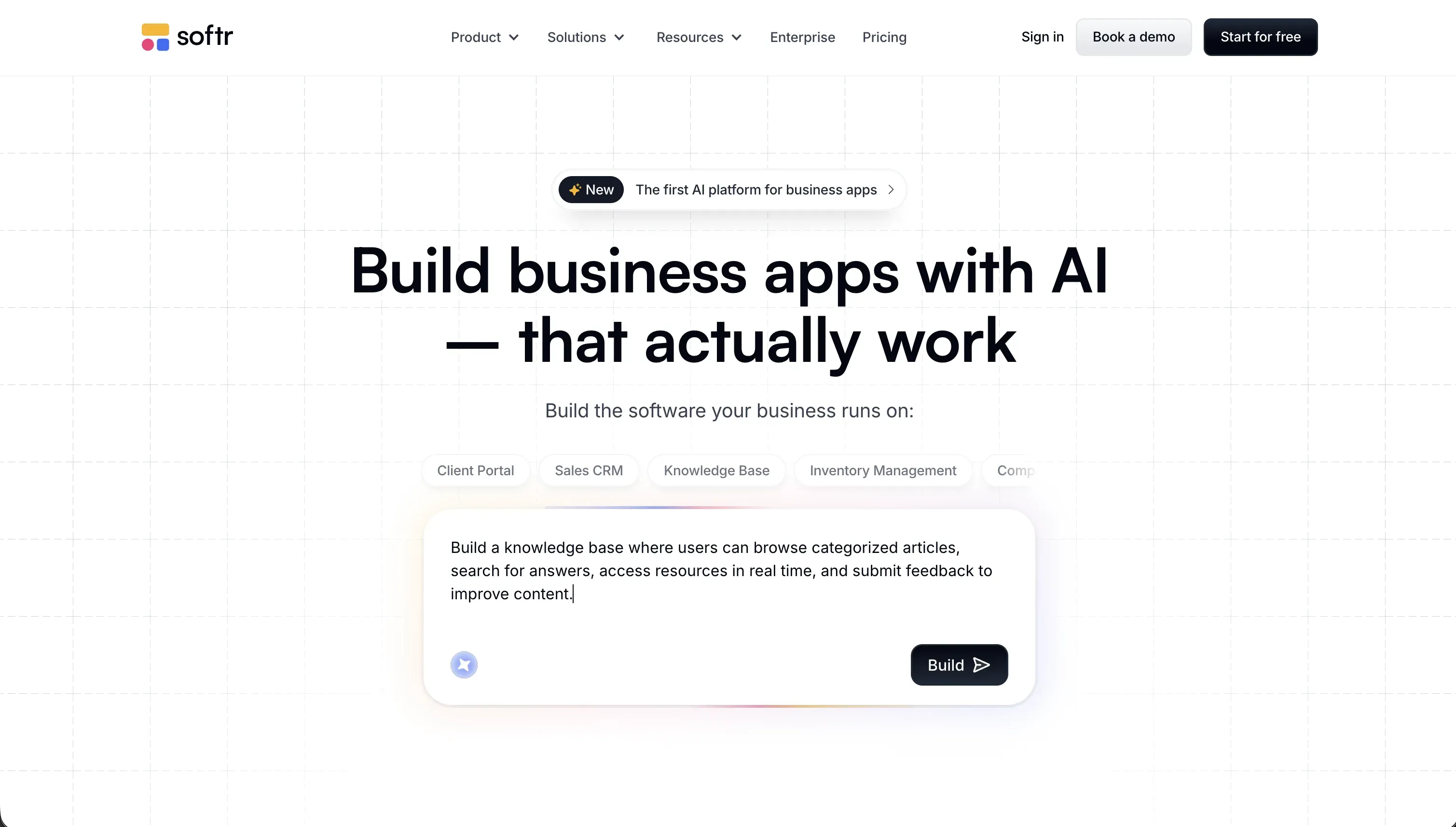 Softr homepage snapshot
A production-ready CRM is essentially a highly secured relational database surrounded by custom views page by page. Softr approaches CRM building with a massive architectural advantage: the critical infrastructure layer is a managed platform responsibility, not a series of raw files generated by an AI. When we set up a sales pipeline, the database, user roles, permission restrictions, and page-routing rules are visual platform features. The AI Co-Builder handles initial database schema creation and block generation from a single prompt, but you remain in full visual control to modify settings without code. You will never get stuck in a ‘prompt loop’ trying to align lead tables or fix broken layout elements.
Softr Databases are native, built for speed and higher record limits than typical no-code competitors, so the frontend isn’t waiting on slow third-party APIs. If you have custom sales triggers or need to pull third-party data directly into a deal, the built-in Vibe Coding block lets you deploy custom-coded components with granular, visually configured permissions. This hybrid workflow isolates custom code to the specific UI block it belongs in, securely handling data connections entirely on the server side to protect sensitive customer data. Full review.
2. Replit - full stack code control for engineering-led platforms
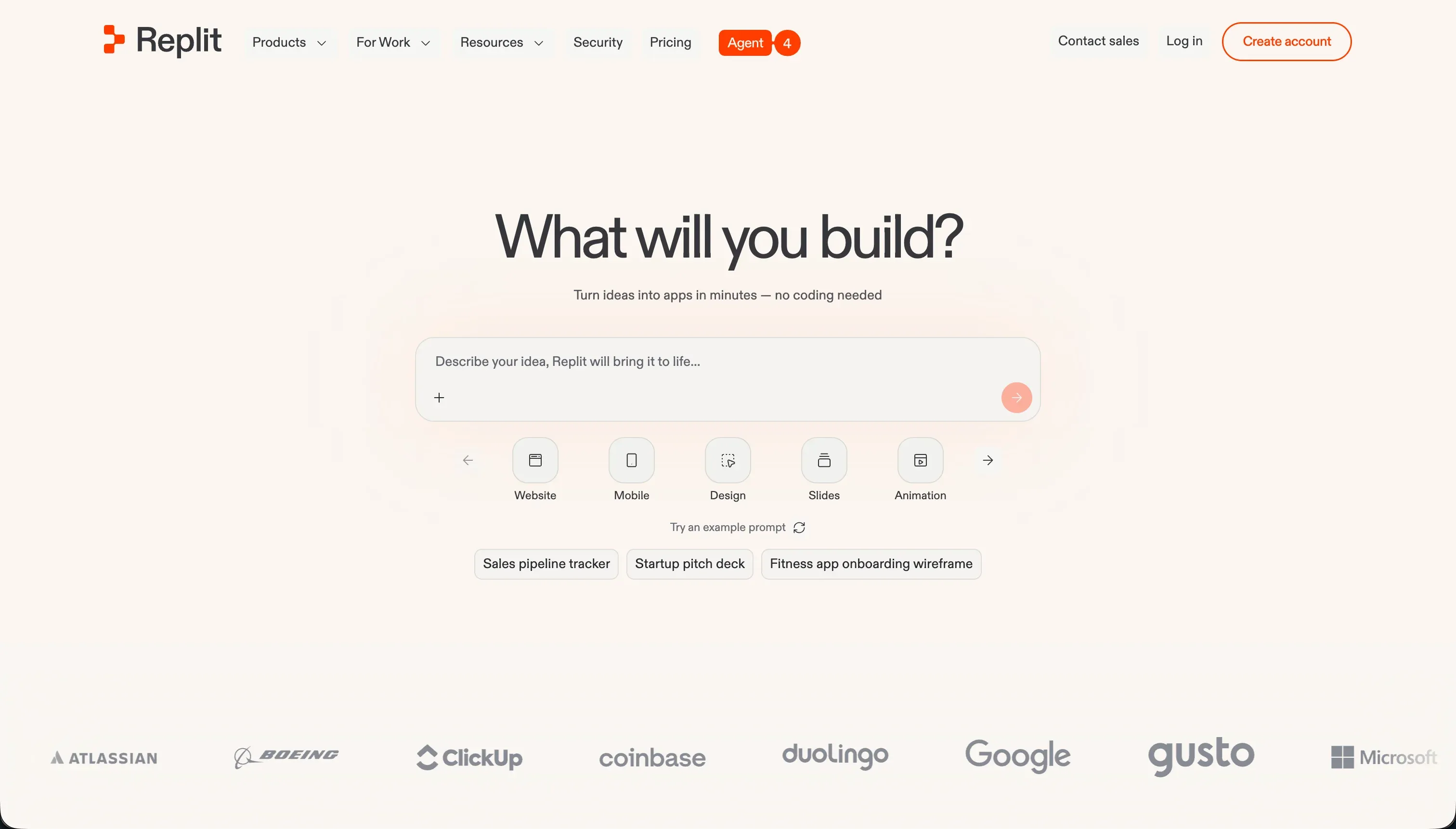 Replit homepage snapshot
Replit Agent enables developers and technical founders to build custom CRMs directly from conversational natural language prompts, producing entirely autonomous stacks with Postgres endpoints. For a developer or a team comfortable editing raw source code, it acts as an incredible accelerator for scaffolding a customized pipeline interface. The agent sets up database migrations and live environments on its own, which makes deep integrations with web services or internal comms tooling realistic from day one.
However, we ranked it below Softr because the output of Replit Agent is real raw code that your technical team is entirely responsible for maintaining. If a package dependency breaks during an update or the agent falls into an infinite loop attempting to debug its own self-correction logic, you will need classic development skills to intervene. Additionally, under intense debugging cycles, compute credit overages can accumulate rapidly on intensive runs. Choose this route only if you have internal developer resources. Full review.
3. Bubble - unlimited operational logic on a mature engine
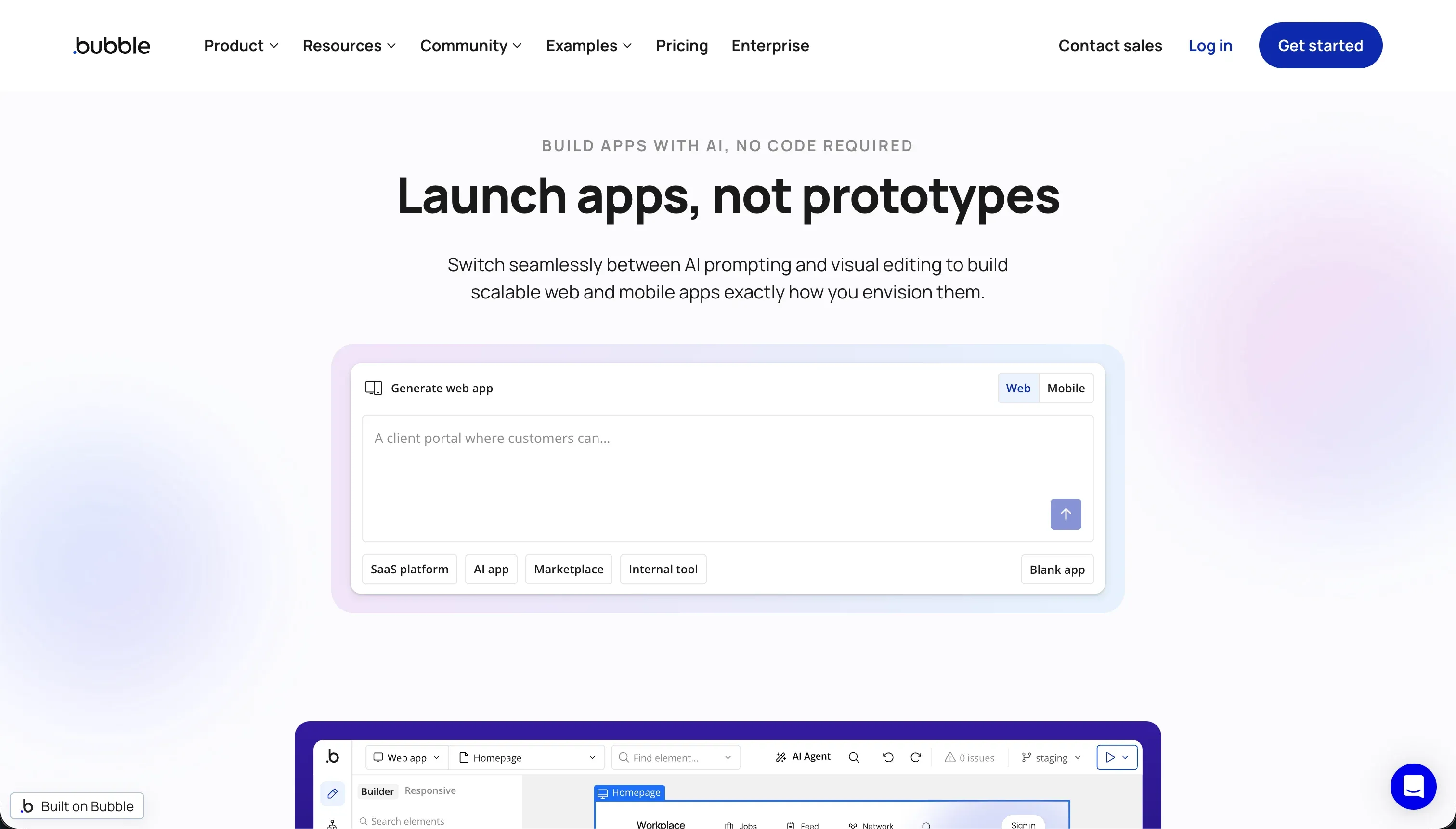 Bubble homepage snapshot
Bubble hosts full-stack relational databases on an established visual programming structure that is highly capable of running complex, multi-user CRMs. The server-side privacy rules engine enables granular field-level and record-level security, ensuring individual sales representatives only view their own designated pipeline segments. The platform features an incredibly deep logical editor capable of constructing custom lead scoring, automated tasks, and complex third-party API callbacks.
The strategic trade-off with Bubble centers on raw complexity and the learning curve. Mastering relational architecture, workflow triggers, and security parameters demands developer-level system design thinking, even though you are not writing literal syntax. Furthermore, the Workload Unit (WU) pricing structure can make pricing highly volatile if your database queries or bulk automated edits are optimized poorly, leading to steep billing spikes as customer datasets balloon over time. Full review.
4. Retool - the developer dashboard built for internal sales pipelines
 Retool homepage snapshot
Retool is the industry standard for admin-style dashboards, connecting directly to real SQL databases and APIs. For a highly technical team building an internal CRM, it lets you construct data-dense tables, deal tracking lists, and customer detail grids visually using their extensive component library. Since it features Retool Database (managed PostgreSQL, editable in a spreadsheet view) and JavaScript hooks throughout, you can wire up stable automated integrations.
We placed it fourth because Retool is not a true no-code tool and is built purely for technical developers. Visual elements are designed for administrative density rather than consumer-grade aesthetic flexibility, and building any workflow beyond the most basic template expects hands-on SQL and JavaScript queries. Furthermore, Retool’s seat-based pricing model charges per individual user, which makes scaling to larger external networks or occasional users highly costly. Full review.
5. Cursor - the power-user editor for software developers building bespoke software
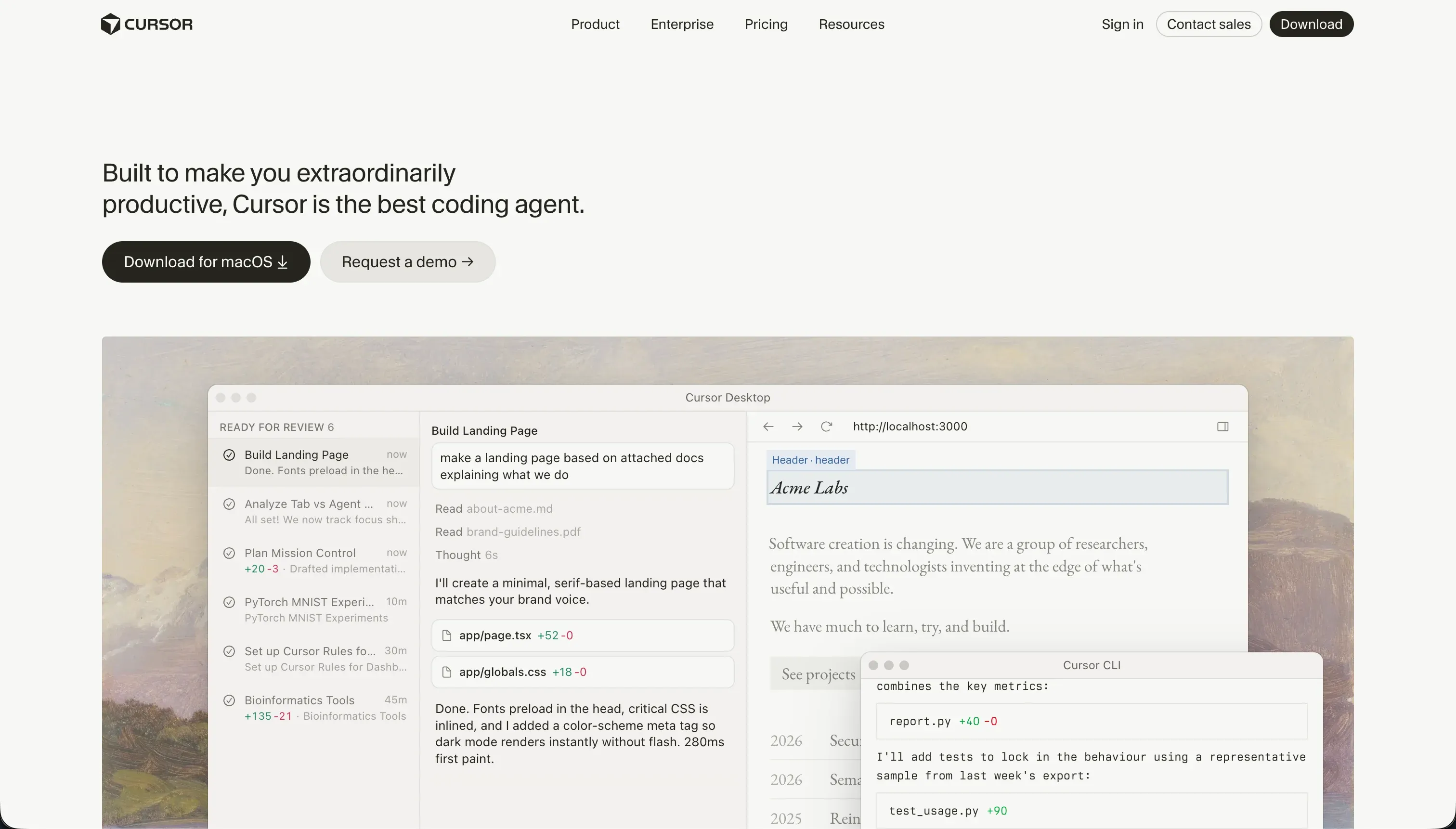 Cursor homepage snapshot
For an engineer or developer building a custom CRM on a standard codebase (like React, Node.js, and Supabase), Cursor is hands-down the best modern tool. Its deep project awareness and Composer agent mode let you index your entire repository and reference files, schemas, and API libraries directly inside a familiar VS Code workspace. It speeds up custom scripting, data validations, and layout refactoring dramatically.
Cursor sits at the bottom of the ranked roster because it is strictly an IDE wrapper for developers; it provides no databases, hosting, or authentication services. If you vibe code a custom CRM here, you are writing manual middleware, configuring your own cloud hosting, and managing structural security rules by hand, representing an enormous operational overhead for non-technical sales teams. Full review.
Also tried: the tools that didn’t make the cut
We also extensively analyzed several other tools that didn’t make our ranked roster. Base44 offers an interesting conversational generator of Postgres databases and auth screens, but community warnings of system outages, lack of white-label auth branding, and structural limitations with multi-user workspace data isolation make it too fragile for real sales pipelines in 2026. Lovable produces stunning sales dashboard prototypes incredibly fast, but builders report significant maintenance overhead, platform update regressions that can break custom code, and complex Supabase RLS security setups that run a high risk of exposing client data if not audited by hand. Zite features an intuitive built-in database, but its lack of code portability, credit-heavy iteration pricing loop, and rigid visual layouts kept it out of the top ranked roster.
How to pick your CRM builder
Who is going to maintain this CRM three months after launch?
| Your situation | Build on |
|---|---|
| Non-technical operational team | Softr - edits stay completely visual with zero code maintenance |
| In-house developers who want code ownership | Replit (with agent) or Cursor (writing custom React) |
| A dedicated visual developer who wants maximum custom database logic | Bubble - but prepare for a real learning curve |
Apply this rule of thumb before launching: test concurrent edits. Invite two team members to submit, edit, and delete dummy deal records at the exact same moment. On Softr, this database-level CRUD is securely managed by the platform architecture. On raw prompt-generated apps, this simple concurrency test is exactly where visual demos crack and silent data corruption begins.