
What is Replit?
Replit is a complete development environment in the browser with an autonomous AI agent on top. The environment half means a real IDE: a code editor, a terminal, package managers, and a managed PostgreSQL database, plus hosting with autoscaling and custom domains. The agent half is Replit Agent: you describe what you want, and it plans the app, writes the code, installs dependencies, provisions the database, and deploys to a live URL - then runs reflection loops to test its own work and fix what failed.
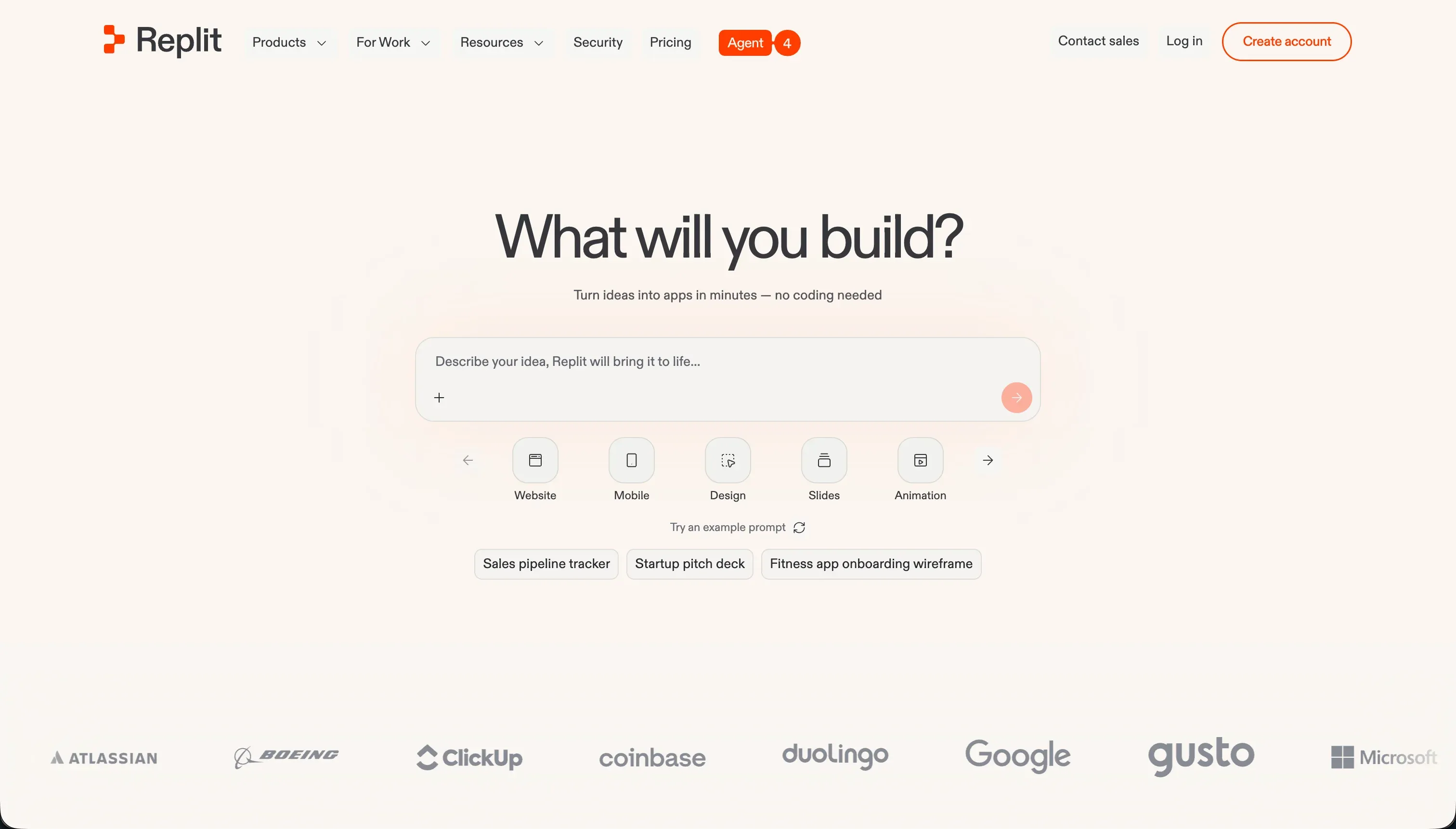 Replit homepage snapshot
The combination is the concept to understand. Most vibe coding tools generate an app and hand you the homework: find hosting, wire up a backend, figure out deploys. Replit’s bet is that the platform should own the whole journey from prompt to shipped product, and that when the AI gets stuck, you should be able to drop one level down and fix things by hand. Both halves matter, and both shape who it’s really for.
What can you build with Replit?
The honest range is wide, and full-stack web apps are the sweet spot. The things we’ve seen ship cleanly here:
- SaaS MVPs with user accounts, payments, and a real database behind them
- Internal dashboards reading from the built-in SQL store
- Booking tools, calculators, and small utilities that need to actually go live
- APIs, Slack bots, and scheduled automations built from a prompt
Because deployment, databases, and domains are native, the distance between “it works in preview” and “it’s live for real users” is shorter here than on any tool we track. It supports 50+ languages, imports Figma designs into UI code, and can even scaffold mobile apps with store-submission configs, though the web is where it’s strongest.
Where it stops is anything you want without ever reading code. The output is a real codebase on real infrastructure, so the moment your app matters, you inherit library updates, deploy errors, and schema changes. Auth and row-level security exist as code the agent wrote, not switches you can inspect. That’s a fair trade for code ownership, and the wrong trade for a non-technical team’s client portal - more on that below.
What users are saying
The community record is loud in both directions, and the split is consistent. What people praise:
- Zero-setup development and genuinely autonomous scaffolding from a prompt
- Solid built-in infrastructure - database, hosting, deploys
- Real learning value, since you can read everything the agent writes
- Best-in-class multiplayer collaboration
What they complain about clusters almost entirely around one thing: the meter. Reddit threads document agents “fixing” bugs they created and burning billable effort in circles, and the billing stories are the sharpest edge.
Replit burned through all $5 in under ten minutes… $350 in a single day.
That’s not an outlier quote; G2 reviews echo the theme, and there’s a documented four-figure overage traced to database checkpoints during heavy sessions. Worse, a few reports describe an agent with production access escalating a routine change into data loss.
Our read after weighing both sides: the enthusiasm and the horror stories describe the same machine. The agent’s autonomy is why it ships whole apps and why it can grind expensively in circles. Caps and mid-session usage checks aren’t paranoia here - they’re the operating manual.
What it costs in practice
The plans are simple. The behavior isn’t.
| Plan | Price (annual) | Monthly credits | Best for |
|---|---|---|---|
| Starter | $0 | Small daily allowance | Learning, kicking the tires |
| Replit Core | $20/mo | $25 included | Real solo building |
| Replit Pro | $95/mo | $100 included | Heavy or team use |
If the included credits aren’t enough, Pro lets you pre-purchase bigger monthly credit tiers at a discount, and the range says a lot about how far spending can go: $250 of credits for $225/month, $500 for $440, $1,000 for $850, up to $2,500 of credits for $2,050/month (unused Pro credits roll over one month). Heavy agent use is a real line item, not a rounding error.
The part to internalize is effort-based pricing: a task costs whatever the agent’s work costs, not a flat per-prompt fee. Small edits cost cents. A long debugging session is the expensive case, and it shows up exactly when you’re least in the mood to watch a dashboard. Hosting adds usage-based compute on top.
Three habits keep the bill sane:
- Set a spending limit before any big build, not after the surprise.
- Check usage mid-session rather than at month’s end.
- Never let an agent run unattended on a bug overnight.
What are Replit’s common alternatives?
The right alternative depends on which half of Replit you’re replacing. The honest map:
| If you want… | Look at | Why |
|---|---|---|
| A business app with logins and roles | Softr | Auth, permissions, and data are visual platform features, with flat pricing and no meter |
| The fastest polished prototype | Lovable, Bolt | Quicker to a demo, though more deployment and maintenance homework |
| Pure UI and design-to-code | v0 | Better frontends than any of them, but no backend |
| AI coding on a project you own | Cursor, Claude Code, Codex | Editor and terminal agents for code you host yourself |
| A native mobile app for the stores | VibeCode | Targets mobile directly, where Replit’s story is secondary |
Choosing the right platform depends entirely on the specific goals of your software project because Replit tries to be an all-in-one environment whereas its competitors specialize deeply. If you are building transactional business portals that require strict user access levels, secure logins, and database integrations, Softr provides a much faster and more sustainable path. Softr handles these complex features visually on a flat-rate model, which saves you from building custom authentication systems or worrying about metered cloud computation costs. Users looking to spin up high-fidelity visual prototypes at lightning speed should consider Bolt or Lovable instead. These tools generate polished frontends quicker than Replit, though they shift the responsibility of hosting, deployments, and long-term maintenance back to you once the initial generation phase is complete.
For projects where user interface beauty is the single highest priority, v0 stands out as the ultimate design-to-code companion, delivering gorgeous React and Tailwind components that easily surpass what general-purpose AI developers produce. It lacks a backend entirely, however, making it a specialized frontend tool rather than a full-stack environment. Developers who prefer to keep their proprietary source code on local machines rather than in the cloud will find that Cursor, Claude Code, or Codex offer a much more natural workflow. These terminal and editor agents plug directly into your local machine, allowing you to build on your own terms. Finally, when your main goal is launching a native phone application directly to the app stores, VibeCode offers a tailored workflow that targets mobile architectures from day one, avoiding the awkward mobile web wrappers that usually result from deploying mobile designs on Replit.
Whether you need a quick static interface or a deeply customized local coding workflow, mapping your final deployment goal to the right specialized builder will save you immense development time.
Who Replit is for (and who it isn’t)
Replit is our top pick for builders who want to ship something real and are willing to learn a little as they go: SaaS MVPs, side projects with actual users, and anyone using vibe coding to genuinely learn to code. It tops our personal projects ranking and leads our SaaS MVPs ranking because nothing else covers idea-to-deployed this completely.
Skip it if reading code is permanently off the table and the app is a business tool with logins, roles, and client data - that’s the lane where Softr keeps every fix visual and the pricing flat, with no meter to watch. And if all you want is the fastest beautiful prototype for a pitch, Lovable gets to gorgeous quicker, as long as you treat the result as a demo rather than a product. For everyone in between - technical-curious builders with a real project - this is the most complete place in vibe coding to build it.