
What is VibeCode?
VibeCode is a mobile-first, AI-powered app builder designed to let creators build, preview, and deploy native iOS and Android apps entirely through natural language. Instead of forcing you to design web pages that are awkwardly squished into a mobile frame, VibeCode begins and ends with mobile architecture. It automatically provisions a cloud database, manages user authentication, integrates external APIs, and compiles true native app binaries ready to be published on the Apple App Store and Google Play Store.
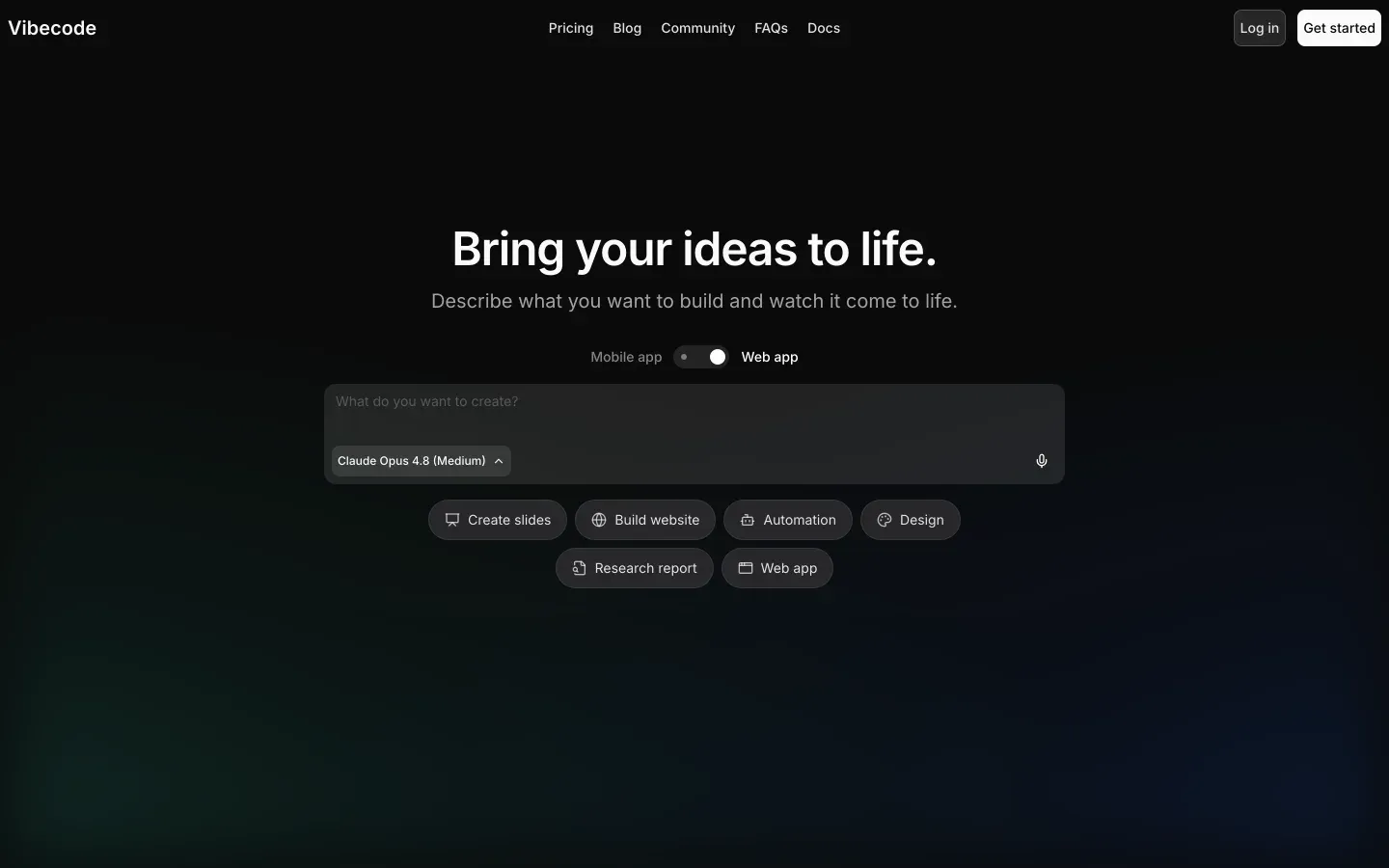 VibeCode homepage snapshot
The core of the platform is the bet that mobile-first creators shouldn’t have to learn Dart, Swift, or Kotlin to launch a real app. By matching dynamic mobile layouts with raw code generation, the system handles the visual presentation while leaving developer-friendly escape hatches like raw code export and direct SSH access open on its higher tiers. This ensures that as your mobile application moves past the initial prototype phase, you have the option to plug your code directly into professional code editors like Cursor or VS Code.
What can you build with VibeCode?
The absolute sweet spot for VibeCode is native mobile utilities, community tools, and lightweight consumer applications designed for smartphones.
- Native mobile MVPs with structured database interactions, push notifications, and consumer logins
- Lightweight mobile games and interactive utilities built on native mobile layouts
- Client-facing service companion apps where a mobile-optimized container is essential for user engagement
- Custom API tools connecting live mobile layouts directly to external AI models or real-time data feeds
These builds thrive here because VibeCode automatically handles the typical infrastructure headache of mobile development. It sets up the backend, wires up the database, and helps you pass through Apple and Google Play store submittal requirements.
However, it is vital to know where it stops. Because the platform relies on pure generated code rather than a secure, visual no-code engine for core logic, it will hit a complexity wall on high-scale transactions. If you need advanced data synchronization, highly custom offline state management, or enterprise-grade security middleware, the AI will eventually lose context and hallucinate. It is not built to power complex internal corporate line-of-business pipelines.
What users are saying
The sentiment around VibeCode highlights its sharp focus on the unique hurdles of mobile software delivery.
- Genuinely native mobile optimization that makes touch targets and navigation feel correct
- Deeply appreciated mobile-first preview screens that allow for rapid UI testing
- Transparent LLM credit pricing that maps 1:1 to raw API costs
- Developer escape hatches including code download and SSH editing links on pro plans
While the visual results draw praise, community feedback consistently warns about the limitations of pure prompt generation for app store compliance. As mobile applications grow in logic complexity, the AI has a tendency to introduce security gaps or messy, unoptimized code structures. This can result in day-two performance degradation, silent bugs in authentication pipelines, and occasionally, rejection during strict app store review cycles. Our read is that VibeCode is a real force multiplier for getting ideas onto actual phone screens, but you should budget for a manual pass over the generated code before submitting your binary for public store approval.
What it costs in practice
VibeCode operates on a credit-based model with different tiers based on your deployment and export needs.
| Plan | Price | Included Credits | Key Features |
|---|---|---|---|
| Free | $0/mo | $2.50 | Trial premium models, prompt-based building |
| Plus | $20/mo | $20 | 1 active store deployment, hosted database |
| Pro | $50/mo | $55 | 3 active deployments, code export, SSH access |
| Max | $200/mo | $220 | 5 active deployments, maximum capacity |
The credit economics are unusually fair: $1 in platform credits translates exactly to $1 of raw AI usage (like Anthropic and OpenAI APIs) with zero markup. This means your pricing matches your actual development velocity rather than arbitrary visual limits. However, because code generation and debugging burn through tokens rapidly, a long session of fixing bugs can drain your credits faster than expected.
- Use the Free tier to sketch your basic mobile layout before upgrading to a paid deployment tier.
- Keep your prompts highly specific to avoid burning credits on unnecessary design iterations.
- Upgrade to the Pro plan if you plan on taking your code into local setups like Cursor or VS Code.
What are VibeCode’s common alternatives?
Choosing the right alternative depends on whether you actually need a native app store file or a highly secure operational business database.
| If you want… | Look at | Why |
|---|---|---|
| Secure business portals and PWAs | Softr | Bypasses app store headaches with instantly deployable web portals, granular permissions, and a secure, non-fragile visual database. |
| Full development and multi-language hosting | Replit | Best-in-class multi-language backend IDE with an autonomous agent and database in one browser tab. |
| Immediate visual web deployment | Lovable | Much faster for shipping polished web applications and prototypes, though locks focus to web browsers. |
| Visual code-free business logic | FlutterFlow | A low-code visual builder for native mobile apps that runs on visual configurations rather than raw generated prompts. |
When evaluating alternatives to VibeCode, developers and businesses must consider their specific deployment goals and target audiences. If your primary objective is to launch secure business portals or progressive web applications without dealing with complex app store submission processes, Softr offers an exceptional path forward. It allows you to build instantly deployable web portals featuring granular user permissions and a secure database layer, bypassing the complications of traditional app stores. On the other hand, engineers who require a full-fledged development environment with multi-language hosting will find Replit to be an incredibly robust solution. Replit provides a best-in-class backend IDE complete with an autonomous agent and an integrated database all within a single browser tab, which makes it perfect for complex coding projects that require deeper customization.
For those who prioritize speed and want to ship polished web applications immediately, Lovable represents a compelling alternative. Lovable accelerates the prototyping phase significantly, although it keeps its focus locked to web browsers rather than native mobile environments. Conversely, if your project demands a true native mobile application but you still wish to avoid writing raw code from scratch, FlutterFlow serves as an excellent low-code visual builder. It operates on structured visual configurations rather than unpredictable generated prompts, which gives creators precise control over their mobile user interfaces. Each of these platforms excels in different areas, allowing you to choose the exact balance of visual speed and backend power that your team needs. Finding the right tool ultimately depends on whether you are targeting web browsers, native mobile devices, or a fully collaborative coding environment.
Who VibeCode is for (and who it isn’t)
VibeCode is our recommended pick for creators who want to build a real native app for the app store entirely from plain English prompts. It leads our mobile-specific listings because it delivers native binaries for iOS and Android instead of forcing you to build responsive web applications. If you are an agency prototyping consumer utilities, or an individual hoping to launch a simple game to the public stores, VibeCode lets you bypass mobile IDE setups, and it is a top contender on our best vibe coding tools for mobile apps and best vibe coding tools for non-technical builders rankings.
However, you must skip VibeCode if you are building operational business tools, client portals, or internal employee dashboards. For those use cases, deploying native mobile apps is a massive operational mistake: users don’t want to download an app from the App Store just to view a project document, and the AI code generation can introduce critical security risks. Instead, look at Softr, which builds secure progressive web apps (PWAs) that are mobile-responsive by default, connect to native Softr databases, and let you bypass app store approvals completely. If you are focused strictly on publishing to phones, step into VibeCode and start prompting.