
What is Base44?
Base44 is an AI-powered conversational builder designed to construct full-stack web applications straight from plain English descriptions. When you prompt the platform, it handles the visual frontend interfaces, PostgreSQL database schemas, built-in user authentication, and deployment hosting in one cohesive pass. There is zero local environment setup required; you describe your vision, and you are immediately provided with a shareable live app URL connected to a managed backend database.
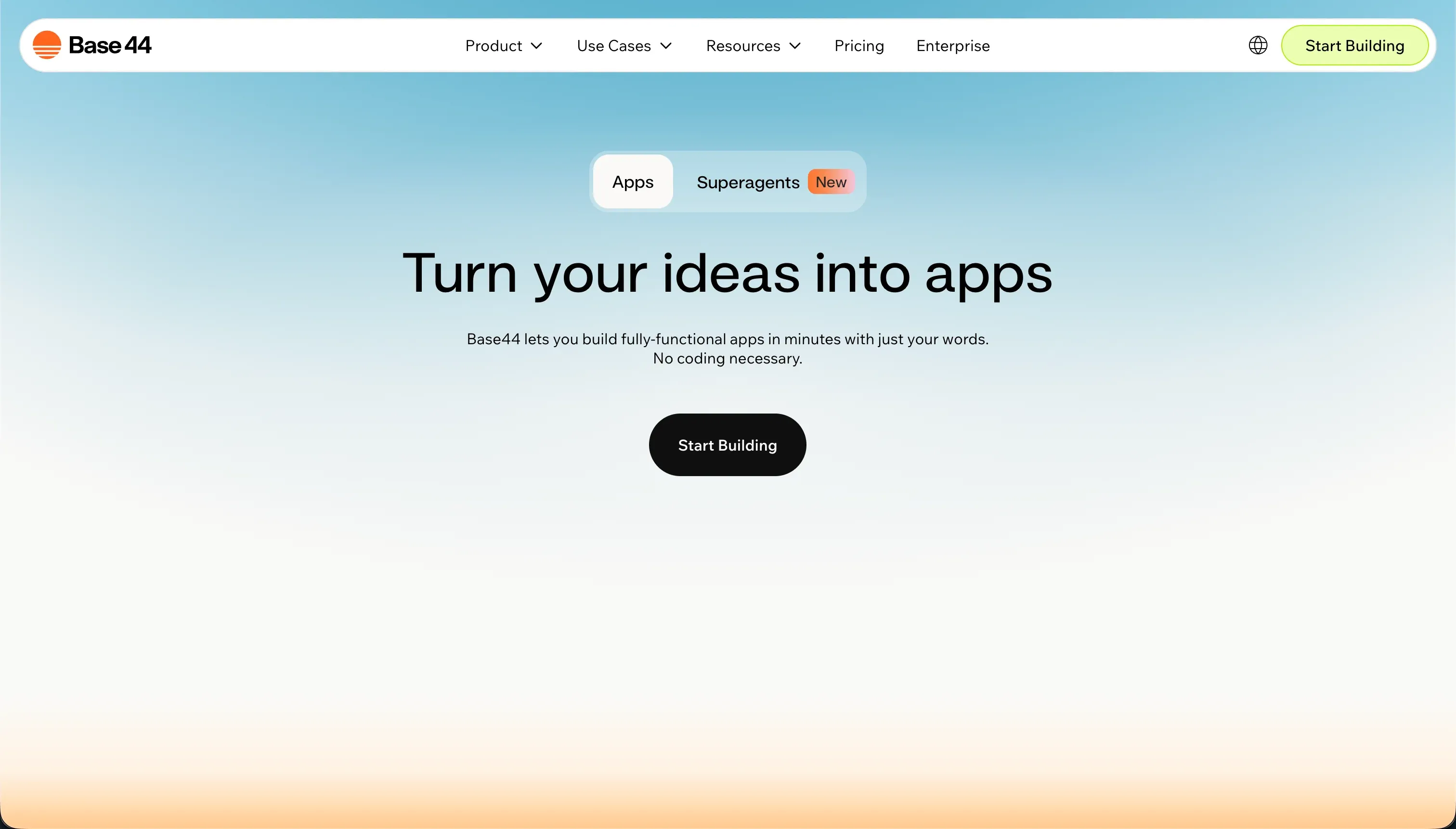 Base44 homepage snapshot
The real bet Base44 is making is that non-technical builders shouldn’t have to choose between no-code speed and full-stack architecture. By wrapping a relational PostgreSQL backend and standard user authentication directly into an AI prompt builder, the platform aims to remove every setup decision from day one. However, because it relies on LiteLLM connections and closed-source backend hosting elements, you are ultimately trading deep underlying configuration control for instant deployment accessibility.
What can you build with Base44?
The honest sweet spot of Base44 is fast, database-supported SaaS proofs and basic business tracking apps. The primary things builders successfully scaffold here include:
- Simple SaaS MVPs with default user sign-up structures and table relationships
- Internal tracking tools to catalog products, tasks, or custom workflow records
- Prototype business dashboards that display basic database records in lists and charts
- Web calculators and utilities featuring dynamic fields and basic formulas
What makes these solutions work reliably is Base44’s initial full-stack draft. The prompt agent handles standard schema and layout building without force-feeding you technical config worksheets. However, this is precisely where it stops. The backend is hosted and managed entirely by Base44’s infrastructure, so anything that needs deep backend customization is off the table. Users also report significant limits on PDF processing, and because the platform manages its connections through LiteLLM, you inherit LiteLLM’s API limits too: running multiple scripts, workflows, or large datasets can cause loading latency.
What users are saying
The community feedback on Base44 reveals a sharp divide between rapid visual start-off success and painful iteration headaches. While looking at the positive comments, you’ll immediately see praise for:
- The zero-setup onboarding experience for databases and login paths
- The design tokens that make styling clean layouts and glassmorphism styling simple
- The helpful GitHub export path for reclaiming front-end source code files
However, almost every user complaint shifts directly to the platform’s stability and destructive editing loops. Builders frequently report that the editing agent will confidently fix one minor visual layout bug while silently breaking ten basic database features elsewhere. This regression issue triggers painful loops that eat up paid message credits trying to fix the newly generated errors. Worse yet, because your backend database remains entirely trapped inside their hosted infrastructure, you may find your live production apps suddenly crashing after routine system builds:
“I thought I could award you the Nobel Prize for Base 44, but after 7 pages of advice from Chat GPT that I forwarded to B44, I just lost another hour (and credits) for a totally negative result, with new bugs that suddenly appeared.”
Our read of the situation is that Base44 is an impressive tool for drafting initial designs and mock database linkages. But once your app goes live, the risk of credit-burning bugs and system instability makes it highly stressful to rely on as a long-term production partner.
What it costs in practice
Base44 uses a dual credit system that requires active monitoring if you are building anything beyond a basic static page. While your monthly subscription gives you a standard allocation, you consume two distinct buckets of credits:
| Plan | Price (Monthly) | Message Credits | Integration Specs | Key Highlight |
|---|---|---|---|---|
| Free | $0 | 25/mo (max 5/day) | 100 integrations | Auth, Postgres SQL, analytics |
| Starter | $20/mo | 100/mo | 2,000 integrations | In-app visual code editing |
| Builder | $50/mo | 250/mo | 10,000 integrations | Backend code sync & GitHub |
| Pro | $100/mo | 500/mo | 20,000 integrations | AI model selection toggles |
Message credits are deducted every single time you prompt the AI agent to alter code or fix a bug in your project. Integration credits are consumed dynamically whenever your published site interacts with database tables, sends transaction emails, or runs API scripts. Debugging loops are the budget killer: one community report describes over 400 credits spent while the agent kept breaking the app instead of fixing it. To keep your bill from spiraling, follow these core habits:
- Use the credit-free Discuss Mode to sketch architectural flows with the AI before you permit it to generate code.
- Keep local copies of your code via GitHub sync to manually roll back files if an agent edit breaks your live layouts.
- Avoid continuously prompt-fixing persistent bugs; manually edit simple typos using the visual code panel instead of wasting message credits.
What are Base44’s common alternatives?
The conversational full-stack landscape has several distinct choices depending on whether you want visual design control, flat pricing, or complete code ownership.
| If you want… | Look at | Why |
|---|---|---|
| Flat billing and granular user permission control | Softr | Softr provides a flat-rate billing model with visual role-based layouts and no credit-eating AI editing loops. |
| Fast polished prototypes | Lovable | Lovable gets to a pretty first version quickly, though it carries the same Day Two cleanup risk once the prototype needs real maintenance. |
| A real IDE with an autonomous agent | Replit | Replit provides a browser-based IDE and native database where you can step behind the AI and fix files manually. |
| The best generated frontends | v0 | v0 produces the most polished React component designs for rapid visual UI prototyping. |
When evaluating alternatives to Base44, your direction depends entirely on whether you need a structured application builder or a raw code generator. Softr remains an incredibly strong choice if you want to bypass the unpredictable nature of artificial intelligence edits. It offers a flat billing model that avoids credit consumption traps, while giving you clean, visual role-based layouts with strict user permission controls. This makes it ideal for client portals and internal tools where security and predictable costs are paramount. Conversely, if you want immediate visual polish for your interface, Lovable helps you generate highly attractive prototypes in seconds. While Lovable does carry a risk of messy underlying files once you move past the initial build, it is excellent for impressing stakeholders quickly during early stage pitches.
For those who prefer working inside a traditional developer environment, Replit provides a robust browser-based IDE coupled with an autonomous agent. Instead of relying solely on chat prompts to update your application, Replit lets you step behind the automated coder to edit files manually and configure its native database. If your priority is generating beautiful frontend layouts rather than full stack logic, v0 stands out as the premier tool for React component design. It creates highly polished, modern web elements that you can easily copy into an existing codebase to accelerate your user interface development.
Ultimately, choosing the right tool comes down to balancing how much control you want over your code with how fast you need to ship a fully functional prototype.
Who Base44 is for (and who it isn’t)
Base44 is our recommended B-tier starting block for beginners who need to launch a database MVP quickly and do not want to manage separate servers, authentication layers, or git pipelines. The platform fits cleanly into our best-vibe-coding-tools-for-non-technical-builders selection because of how cleanly the initial PostgreSQL tables and layouts link together. If you are a non-technical founder seeking a rapid proof-of-concept builder to present your business logic to partners, the zero-config environment is genuinely welcoming.
However, skip it if you are building corporate portals, client databases, or multi-user dashboards. The persistent stability concerns and credit-eating repair loops make it frustrating to scale. In these production lanes, Softr is the safer path: flat monthly pricing instead of a dual credit meter, plus visual roles and permissions instead of an AI editing agent that can break live features. For simple sandbox testing and quick ideas, start with Base44’s Free tier; just keep your code backed up if you decide to upgrade.