
What is Softgen?
Softgen is a chat-based AI builder for creating simple web apps from natural-language prompts. You describe the app you want, and its Cascade AI Agent generates page layouts, basic database structures, and default authentication flows without a visual canvas. Instead of dragging blocks around, you keep refining the app by asking the assistant to change structure, styling, or features.
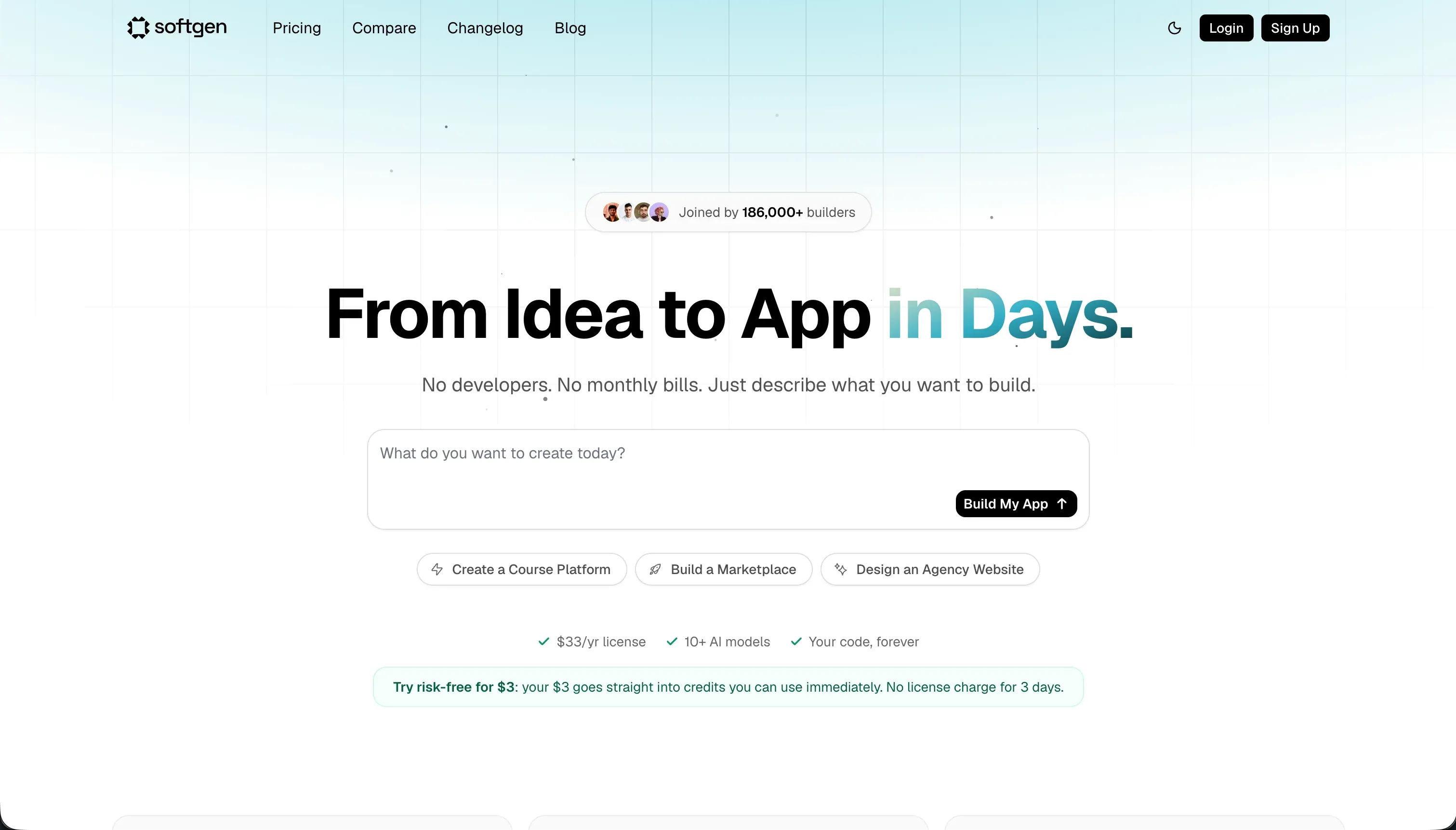 Softgen homepage snapshot
The mental model is prompt-first app scaffolding: Softgen trades manual control for speed and a very low base price. That matters because the tool can get you from idea to working draft quickly, but it also means the quality of the result depends heavily on the platform’s templates and how well the AI interprets repeated change requests.
What can you build with Softgen?
Softgen’s honest sweet spot is simple, structured web apps that can live inside a fairly standard template.
- Simple directories with searchable listings and basic filters
- Early SaaS prototypes with landing pages, login, and lightweight payment flows
- Basic internal databases for mapping linked records and user accounts
- Personal side projects that need a working frontend fast
These work here because Softgen handles the repetitive first-pass setup well: auth, database scaffolding, and standard page structure are all things an AI generator can assemble quickly when the shape of the app is conventional. If your goal is to validate an idea, sketch a workflow, or publish a lightweight app without much design polish, that trade-off can be attractive.
Where it stops is custom software that depends on precise UI control, deeper permissions, or complex operational logic. It is not the right tool for advanced internal tools, heavily branded products, or business portals where every page rule and state change needs tight manual control.
What users are saying
Community feedback follows a clear pattern: people like how fast Softgen gets them to a first version, but they worry about what happens after that.
- Builders praise the speed of generating an initial layout from a single prompt
- Users like having database templates ready without manual setup
- The low $33 yearly entry price stands out against monthly no-code subscriptions
- Code export is seen as a useful escape hatch if the project outgrows the platform
The complaints consistently center on customization friction and credit usage. Users report that spacing, alignment, and styling tweaks can turn into repetitive prompt loops, and that once they move past the first generated version, manual code edits may be needed to get the result they want. The biggest practical concern is that visual iteration can consume paid credits quickly, which weakens the value of the low base price if your app needs lots of refinement.
Our read: Softgen is strongest as a fast first-draft machine, not as a polished long-run app builder. The positive reactions are real, but they are mostly about day-one speed rather than long-term control.
What it costs in practice
| Plan | Price | What you get | Best for |
|---|---|---|---|
| Annual Membership | $33/yr | Platform access and hosting rights | Solo builders who want a cheap entry point |
| AI Usage Credits | Pay-as-you-go | Credits for generation and updates | Builders actively iterating with prompts |
Softgen splits cost into two layers: a very cheap base membership and separate AI usage. That keeps the barrier to entry low compared with monthly app builders, but the real bill depends on how often you ask the AI to regenerate or adjust things. If your build fits the first template well, costs can stay modest. If you keep reworking layout and styling through chat, spending can rise quickly because each round draws from credits.
In practice, the biggest budget risk is not the annual fee but repeated visual iteration. Builders should treat the $33 price as access, not as the full project cost, especially if the app needs multiple rounds of refinement.
- Plan your database and page structure before you start prompting.
- Use Softgen for the first draft, not endless visual tweaking.
- Export the code once customization pressure starts driving credit use up.
What are Softgen’s common alternatives?
The best alternative depends on whether you need more visual control, more code ownership, or more scalable app structure.
| If you want… | Look at | Why |
|---|---|---|
| Stable visual builders with permissions | Softr | It gives you visual block editing and stronger user-access controls without prompt-driven layout changes |
| Full code with AI help | Replit | It is better for developers who want direct code ownership plus backend and deployment in one place |
| Advanced visual app building | FlutterFlow | It offers much deeper UI control and a more production-ready path for custom apps |
| Frontend freedom with backend flexibility | WeWeb | It is stronger when you need exact interface control connected to your own backend stack |
When you look beyond the prompt-to-app workflow of Softgen, several alternatives offer different levels of control over your design and structure. If you feel restricted by conversational generation and want a more predictable building process, Softr serves as a strong alternative. It relies on a structured library of visual blocks that you can snap together to create customer portals and internal tools. This approach eliminates the guesswork of AI layout changes and gives you robust user-access controls, which are essential when you need to secure sensitive data based on user roles.
For those who prefer direct code ownership and deeper customization, platforms like Replit and FlutterFlow step up the capabilities. Replit is perfect if you want to write and edit raw code with the help of artificial intelligence, allowing you to manage your backend, frontend, and deployment altogether in one place. FlutterFlow, on the other hand, provides a visual workspace that generates clean code for mobile and web applications, offering a highly production-ready path with precise visual control. If you require absolute frontend freedom but want to keep your backend options open, WeWeb allows you to construct intricate interfaces visually while letting you connect to any database or external service you choose.
Evaluating these options helps you find the right balance between rapid setup and long-term flexibility for your specific development needs.
Who Softgen is for (and who it isn’t)
Softgen is a good pick for solo builders who want the cheapest possible path to a simple working MVP. If you mainly need a directory, lightweight SaaS mockup, or personal project draft, it fits readers exploring best vibe coding tools for personal projects and similar fast-build workflows.
Skip it if your app needs polished custom UI, serious permissions, or lots of iterative design changes. In that case, a tool like Softr will usually be easier to control and safer for real business workflows. If your project already feels bigger than a template, move on early and you will save time.